Every day, tens of thousands of patients worldwide are energetically tested and harmonised using Bioresonance according to Paul Schmidt. An important basis for this cause-oriented treatment method is the Rayonex Analysis and HarmonisationWhen frequency spectra are transmitted to the body via the patented detectors using Bioresonance devices according to Paul Schmidt, this is known as harmonisation. Harmonisation refers to the process of... More System (RAH).
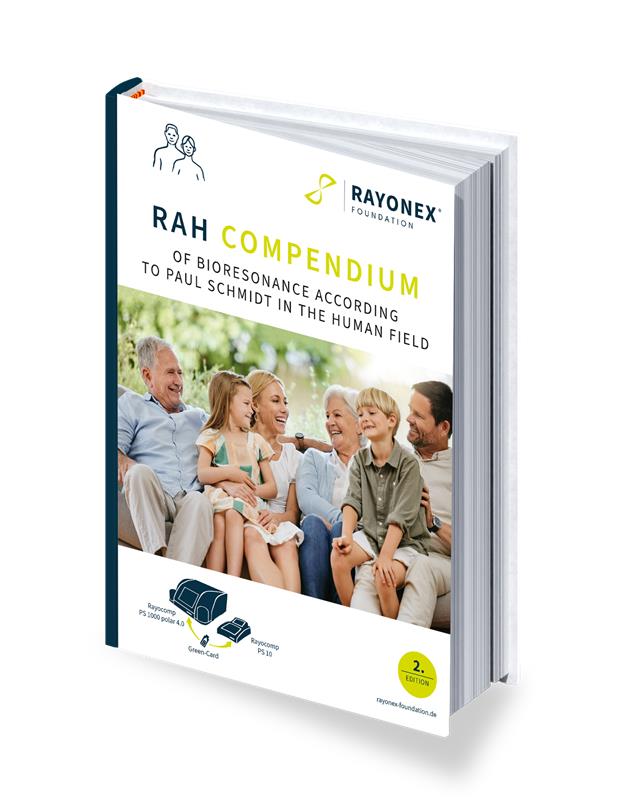
Numerous publications have appeared on both the many possible applications of Bioresonance according to Paul Schmidt and the RAH. Building on this, this second, revised edition of the RAH Compendium brings together all the information on Bioresonance according to Paul Schmidt in the human field into a comprehensive reference work. This also includes all the innovations that have resulted from the continuous further development of the system by national and international bioresonance experts.
The RAH Compendium presents the basic principles of Bioresonance according to Paul Schmidt, explains the structure of the RAH and provides information on its application in both the Rayocomp PS 10 and the Rayocomp PS 1000 polar 4.0: An orientation guide illustrates basic procedures in energetic analysis and harmonisation. Building on this, the RAH programs are described, organ-related meridian and pathogen tables are presented, and important information on pathogens (bacteria, viruses, parasites, fungi) and the cause-oriented treatment approach is provided. In addition, the many RAH Test Protocols are discussed and it is described which RAH programs should be analysed and harmonised for which clinical picture from a holistic perspective. Furthermore, all currently available Compact Programs and the corresponding RAH programs are listed. New additions to the second edition include the Test Protocols for the ten most common childhood diseases. Finally, you will find basic information on the C-Module, such as a list of the various RAH programs, an overview of the Test Protocols, consisting of a non-specific and a specific part, as well as information on the legal framework for using the C-Module.